average revenue increase with compounding personalization
Turn fragmented user data into compounding personalization
You're sitting on a goldmine of product data — but your AI treats every user the same. Clarity builds persistent self-models that make your product smarter with every interaction.
What's breaking
Users churn because your AI feels generic after 90 days
Onboarding surveys capture stated preferences, not real behavior
Your recommendation engine optimizes for engagement, not alignment
What changes
2.1x retention through belief-aligned personalization
Cold-start solved in 3 interactions, not 30
Revenue compounds as self-models deepen
Related articles




Why Your AI Agent Forgets What You Told It Yesterday
AI agents forget because they treat each interaction as stateless transactions rather than continuous relationships. This architectural limitation forces users to rebuild context repeatedly, creating friction that erodes trust and engagement.

How Self-Models Work
Self-models are persistent, structured representations of what an AI product understands about each user. They track beliefs with confidence scores, evolve through interaction, and give AI products the ability to get meaningfully better for each person over time.

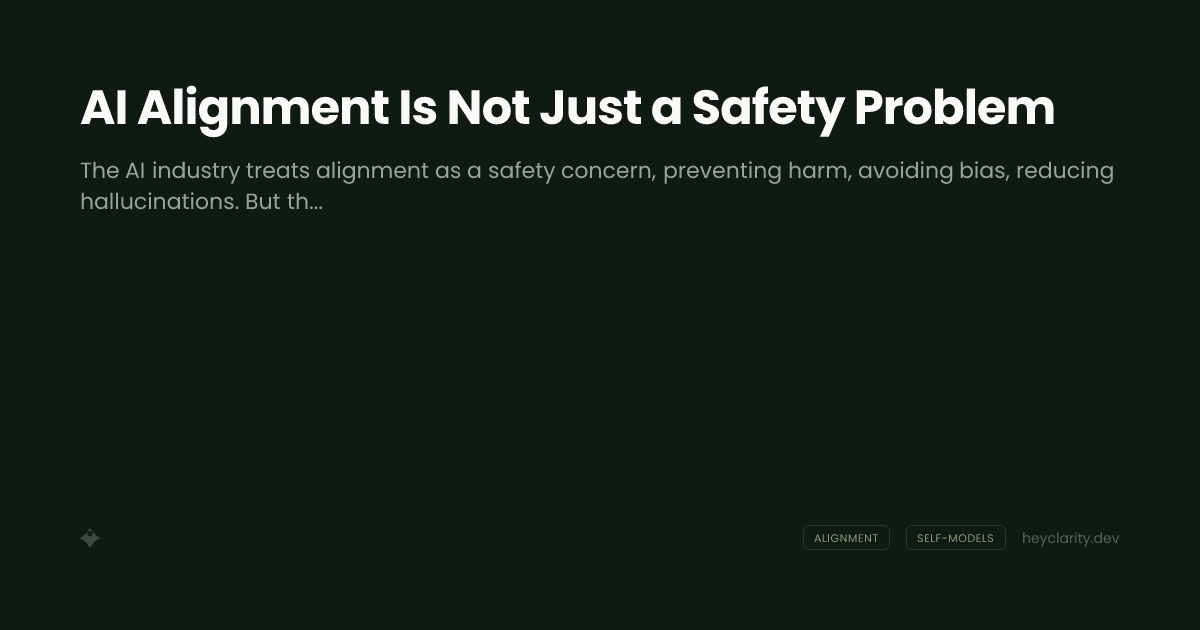
AI Alignment Is Not Just a Safety Problem
The AI industry treats alignment as a safety concern, preventing harm, avoiding bias, reducing hallucinations. But there is a second alignment problem that nobody talks about: aligning AI outputs with what individual users actually need.
Ready to build AI that actually knows your users?
You're sitting on a goldmine of product data — but your AI treats every user the same. Clarity builds persistent self-models that make your product smarter with every interaction.
Stay sharp on AI personalization
Daily insights and research on AI personalization and context management at scale. Read by hundreds of AI builders.
Daily articles on AI-native products. Unsubscribe anytime.